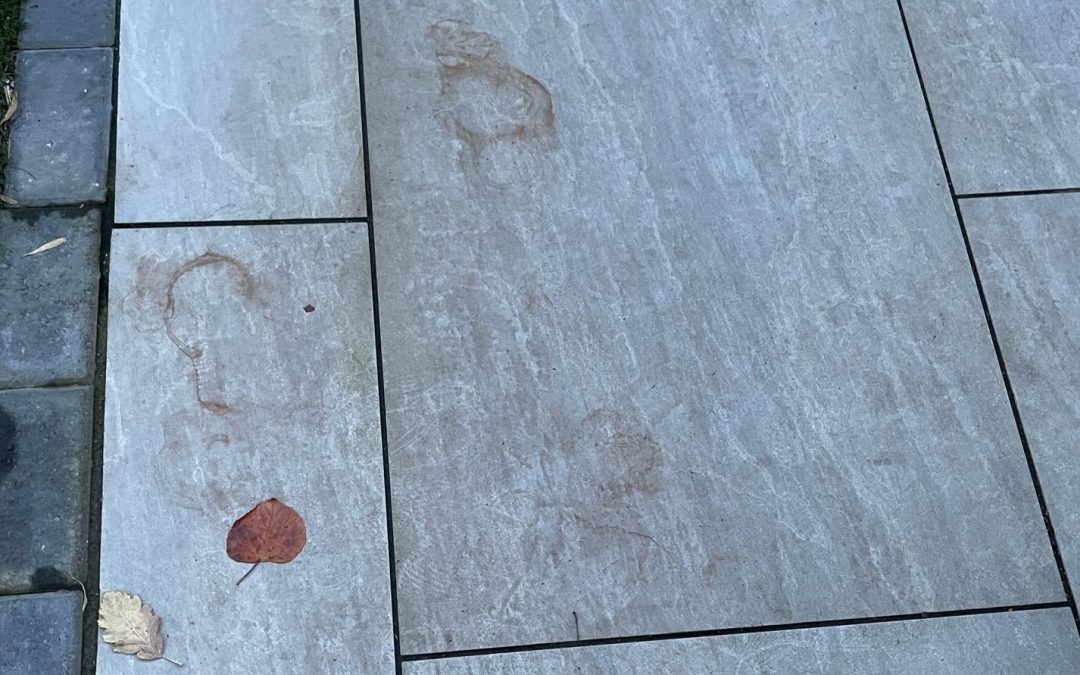
Have you ever noticed dark leaf-shaped marks or stains appearing on outdoor porcelain paving? This is a common issue, particularly during autumn and winter, when falling leaves, damp conditions and wet weather are more frequent. These marks are often caused by tannins – naturally occurring compounds found in leaves, plants and trees.
Tannins belong to a group of compounds known as polyphenols. While they play an important role in protecting plants and trees in nature, they can also leave stubborn discolouration on paving surfaces.
What are tannins?
Tannins are very common in leaves, especially the top surface, and in roots and heartwood of trees. In each case, they act as a natural preservative and pesticide. Tannins are also found in food and drinks, like tea, coffee and wine, in which they contribute to an astringent taste. That same astringency makes leaves and trees less tasty too, offering protection against herbivores.
Because tannins are water-soluble, their molecules are easily transferred onto other surfaces, including outdoor porcelain paving, paths and patios. As leaves become wet and begin to break down, tannins can leach out and transfer more readily onto paving. Tannin is also corrosive to ferrous metals and can cause blue-black staining if it comes into contact with iron-rich stone. Staining is also common underneath or near wooden garden structures, like pergolas, gazebos and furniture, where tannins can be washed from the surface of the timber. Oak is particularly rich in tannin or tannin acid. However, when it comes to wooden structures, issues can often be avoided if the timber is properly seasoned or primed.
How to remove tannin stains from porcelain tiles
With autumn leaves and changing weather bringing increased moisture to outdoor spaces, it’s a good time to tackle any tannin staining before it becomes more established.
To remove marks caused by leaves and nearby timber structures, we recommend applying ECOPROTEC Intensive Cleaner, diluted 1:3 with warm water, onto the stain. If the staining is particularly prominent, the surface can be agitated with a scrubbing brush or black pad straight after application. The treatment should then be left to react for 5-10 minutes, with more solution added if it starts to dry out. The tiles should be agitated again and the residue wiped away with a sponge or mop. Finally, the tiles should be rinsed with clean water. In extreme cases, neat solution can be used and the same method applied.
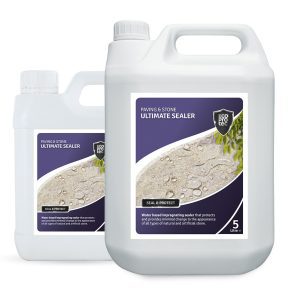
To protect porcelain tiles from future tannin staining, we recommend barrier treatment, ECOPROTEC Pre Grout Protection – a non-film forming solution that creates a barrier against moisture and organic matter and makes ongoing maintenance easier. Being water-based, the treatment can be applied over some residual moisture. As a rule of thumb, it’s generally safe to apply over the autumn and winter provided that no rain is forecast for 24 hours, either side of application.

For further information, browse ECOPROTEC TV on YouTube or contact the ECOPROTEC team direct on 01823 662722 or email technical@ecoprotec.co.uk